


Until the advent of materialism and 19th c. dogma, Western Civilisation was superior to anything Islam had developed. Islam has not aided in the development of the modern world; in fact civilisation has only been created in spite of Islam. Proof of this resides in the 'modern' world and the unending political-economic and spiritual poverty of Muslim states and regions. Squatting on richer civilisations is not 'progress'. Islam is pagan, totalitarian, and irrational.

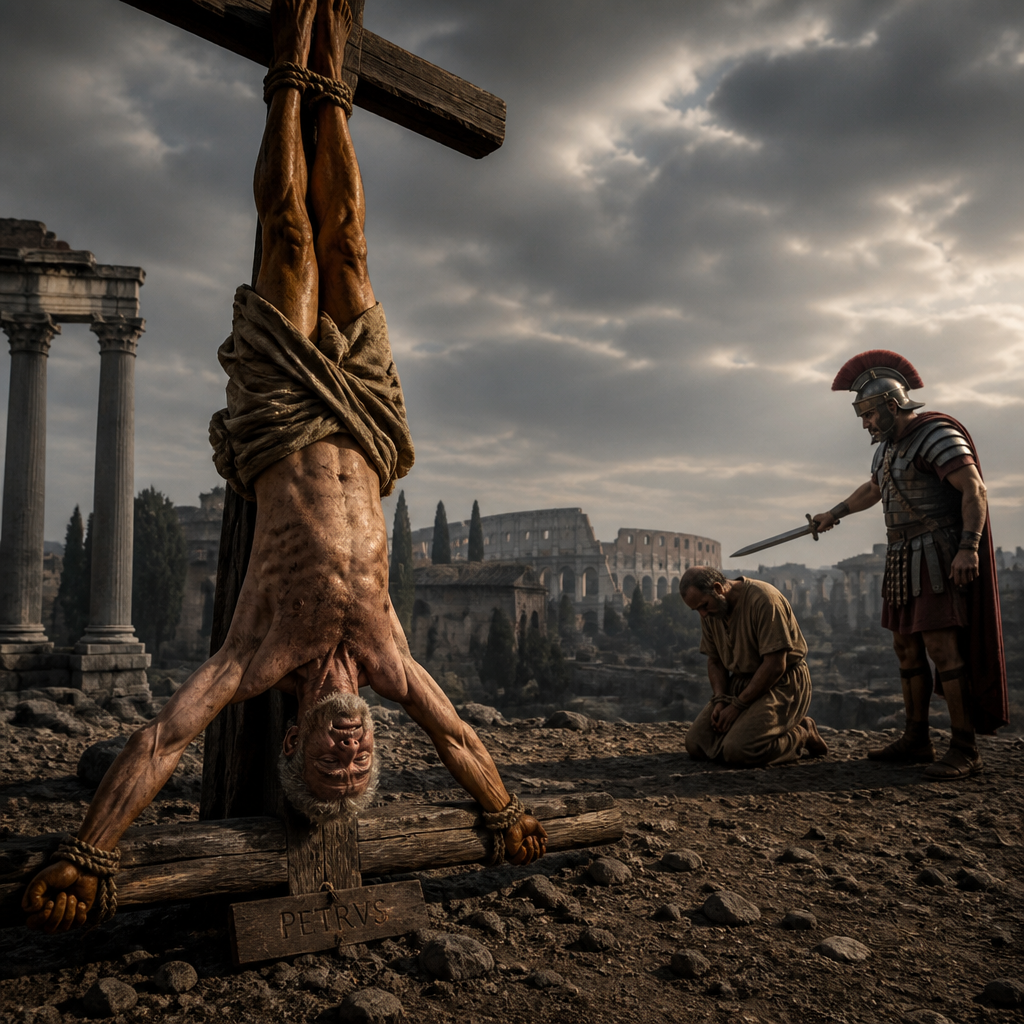
By the year 75, the two men who had done more than any others to carry the crucified Jewish messiah out of Judaea and into the imagination of the wider world were both dead. Peter, tradition insisted, had been crucified upside down across the Tiber, unwilling in his humility to die in the same posture as his Lord. Paul had gone the more dignified Roman way, beheaded on the Ostian Road, a citizen's privilege denied to lesser men. Nero, the emperor who had killed them both to give the Roman mob someone to blame for the fire that gutted half his capital in 64, was himself four years dead by his own hand, and the empire had spent a chaotic year cycling through four emperors before Vespasian, a bluff Sabine general, restored some order. In the same years, Vespasian's son Titus had ground Jerusalem into rubble, torn down the Temple whose destruction Jesus himself was remembered to have foretold, and marched its treasures through Rome in a triumph whose arch still stands. Judaism's ancient centre of gravity - sacrifice, priesthood, Temple - had been extinguished in fire and Roman siege engines. The young movement that had sprung from a Galilean carpenter's execution under Pontius Pilate had, by any reasonable actuarial expectation, arrived at the moment of its extinction. It had lost its founding pillars. It had lost the geographical and institutional womb - Jerusalem, the Temple, the mother church of James - from which it had first drawn breath. It was a suspect, illegal, foreign superstition with no emperor's favour, no army, no landholdings, and a founder who had been executed as a common criminal.
And yet the seventy-five years that followed - the span this folio covers, 75 to 150 AD - are the years in which Christianity did not die. It organised itself. It multiplied. It began to write down, sift, and treasure its own memory. It produced men willing to walk to Rome in chains composing love letters to death along the way. And it built, almost invisibly, the scaffolding - bishops, creeds, canon, liturgy - on which everything that would later be called Western civilisation would eventually be raised. This is the story of that unlikely survival.
The word "pope" did not yet mean what it would come to mean. There was no Vatican, no conclave, no claim yet fully articulated to universal jurisdiction. What existed in Rome was a small, watched, largely immigrant and freedman congregation meeting in private houses, led by a succession of elders whom later tradition - Irenaeus of Lyons, writing a century afterward, and the Liber Pontificalis compiled later still - arranged into a tidy numbered list. The list itself is a retrospective act of order-making, and its earliest entries are more securely attested than its precise dates. But the men are real, and their sequence tells its own story.
Clement of Rome, traditionally the third bishop after Peter (after Linus and Anacletus/Cletus), is the first to leave a text we can actually read. Around the year 96, with the persecuting emperor Domitian recently dead and the church at Corinth convulsed by a squalid internal power struggle - younger men had deposed older, legitimately appointed presbyters - Clement wrote a long letter of remonstrance from the Roman church to the Corinthian one. What is startling about 1 Clement is its assumption of authority: a church with no scriptural mandate to intervene nonetheless writes as though it has every right to instruct another church, hundreds of miles away, on how to order itself, invoking the pattern of Old Testament priesthood and the apostolic succession - bishops and deacons appointed by the apostles, who appointed successors in turn, "that when they should fall asleep, other approved men should succeed to their ministration." It is the earliest evidence outside the New Testament of a Roman church already thinking of itself as possessing a peculiar responsibility for the whole body of believers - the seed, whatever one makes of later claims, of Rome's primacy.
After Clement came Evaristus, then Alexander I, then Sixtus I, then Telesphorus - a name later tradition remembered as a martyr - then Hyginus, reaching just past our period into the 140s with Pius I. Their biographies are, frankly, almost blank to us; what matters is the fact of unbroken succession itself, carefully rehearsed a century later by Irenaeus precisely because it mattered to Christians that authority could be traced, name by name, back to men who had known the apostles.
Rome was not alone in this. In Antioch, the church that Acts tells us first gave the movement its name "Christian," a bishop named Ignatius governed with a ferocious, almost obsessive theology of the episcopate. For Ignatius - of whom much more below - the bishop was not merely an administrator but the visible guarantee of unity, the figure in whom the whole community was gathered up: "Do nothing without the bishop," he told the Christians of Tralles and Magnesia and Smyrna, in letter after letter, as though a still-forming institution needed the truth hammered in through sheer repetition. In Smyrna, a bishop named Polycarp - of whom, again, more below - held a see for decades, becoming a living bridge between the apostolic generation and the middle of the second century. In Jerusalem, remarkably, the leadership of the mother church had passed to Symeon, a cousin of Jesus, after James the Just had been murdered by the Sanhedrin around 62; Symeon is said to have led the Jerusalem Christians in their flight to Pella before the Roman siege closed the city, preserving a Jewish-Christian remnant that would nonetheless dwindle in significance as the movement's centre of gravity shifted decisively toward the Gentile, Greek-speaking cities of Asia Minor, Greece, and Rome itself.
What emerges from this scattered evidence is a pattern that would prove decisive for everything after: government by a single bishop in each city, advised by a council of presbyters and served by deacons, each see understanding itself as one link in a chain reaching back to an apostle, and each in loose, letter-writing communion with the others. No emperor designed this. No lawyer drafted it. It grew, house church by house church, out of sheer practical necessity and a shared conviction that the apostolic testimony had to be guarded, not reinvented, by every subsequent generation.
Of the Twelve, John was remembered as the last to die, reputedly at Ephesus, at some point around the end of the first century, having outlived every other apostle by decades. That longevity mattered enormously, because it meant John's personal memory bridged the entire gap this folio covers. Men who as young disciples had sat at his feet were, by 110 or 120 or even 150, elderly bishops themselves - living, breathing links to an eyewitness of the risen Christ, at exactly the moment such links were becoming irreplaceably scarce.
Two men above all carried that inheritance forward. Polycarp of Smyrna, according to Irenaeus (who as a boy had himself heard Polycarp preach and never forgot it), had been "instructed by apostles, and conversed with many who had seen Christ" - and specifically with John. Polycarp governed Smyrna for perhaps sixty years, dying an old man in the 150s, and in that long tenure he became something the young movement badly needed: a living guarantee that the faith being preached in the mid-second century was continuous with what the apostles had actually taught, not a Gnostic reinvention. When later heretical teachers tried to win him over, Irenaeus records Polycarp's blunt verdict on Marcion, father of one such heresy: "I know thee, the first-born of Satan." That was not merely temperament. It was the fierce protectiveness of a man who had heard the truth first-hand and would not see it adulterated.
Papias of Hierapolis, a contemporary of Polycarp and by his own account also a hearer of John (or possibly of "John the Elder," a distinct figure - the sources are genuinely tangled here, and honesty requires saying so), set himself the task of collecting, from those who had known the apostles or their immediate followers, everything he could of what "Andrew or Peter said, or what was said by Philip, or by Thomas or James, or by John or Matthew." His five-volume Expositions of the Sayings of the Lord survives only in fragments quoted by later writers, but those fragments are precious beyond their length, because Papias is our earliest external witness to the writing and authorship of the Gospels - he is the source, ultimately, for the tradition that Mark wrote down Peter's preaching and that Matthew compiled a collection of the Lord's sayings. Whatever one makes of the details, Papias represents something new and urgent in the Christian mind of this period: an anxiety, while living witnesses could still be consulted, to fix the oral memory before it dissolved.
This is the deeper significance of "John's disciples" for the Church's future. Christianity, unlike the mystery religions and philosophical schools with which it competed for converts, staked everything on a set of claims about specific, recent, checkable events - a man really executed, really seen alive afterward, by named people, in a named place, within living memory. The generation of Polycarp and Papias was the last generation that could personally youch for the chain of custody between the apostles and the Church of their own old age. That they used those decades so deliberately - writing, collecting, correcting, refusing corruption - is a large part of why the memory of Jesus reached the fourth century, and eventually us, in a form recognisably continuous with its origin rather than dissolved into competing myths.
To a Roman administrator in, say, 110, Christianity was a minor irritant - a superstitio, in Tacitus's contemptuous word, a "deadly superstition" that had broken out again after being checked, "not only in Judaea, the source of the evil, but even in Rome, where everything hideous and shameful in the world collects and becomes fashionable." Suetonius, writing under Hadrian, mentions "Chrestus" causing disturbances among Rome's Jews under Claudius and dismisses Christians as a class of men "given to a new and mischievous superstition." Neither writer thought the movement worth more than a sentence or two. That contempt is itself the measure of how little the empire's elite understood what was growing beneath its notice.
The clearest window we have onto the movement's actual reach comes not from a Christian source at all but from a nervous imperial governor. Around 112, Pliny the Younger, newly appointed to govern Bithynia-Pontus on the Black Sea coast, wrote to the emperor Trajan in some perplexity. Anonymous accusations had brought a flood of alleged Christians before his tribunal - so many, he reported, "of every age, every rank, and of both sexes," that "the contagion of this superstition has spread not only through the free cities, but into the villages and rural districts." Temples, he noted with evident relief, had begun to be frequented again and the sacrificial meat trade to revive, now that his prosecutions had frightened people back to the old gods - testimony, backhandedly, to how far Christian numbers had already cut into ordinary civic and religious life in provincial Anatolia. Under interrogation, apostates told Pliny that the Christians' worst crime was to meet before dawn on a fixed day, sing a hymn "to Christ as to a god," bind themselves by oath not to commit theft, adultery, or breach of trust, and later reassemble to share a common meal of "ordinary and harmless food." Trajan's rescript in reply - Christians were not to be hunted out, anonymous denunciations were to be ignored, but those who persisted when formally charged and refused to sacrifice were to be punished - became, in effect, imperial policy for the better part of a century: the Church was illegal, but its extermination was nobody's priority.
By the time Hadrian toured the eastern provinces in the 120s, the pattern was familiar enough that the proconsul of Asia, Minucius Fundanus, wrote asking for clearer guidance, and Hadrian's rescript in reply essentially reaffirmed Trajan's: due process, no mob justice, no reward for false accusers. The very existence of this bureaucratic correspondence tells us Christianity had become common enough, from Bithynia to Asia to Rome itself, to be a recurring administrative headache rather than a one-off nuisance.
Geographically and socially the movement was overwhelmingly urban and, in this period, still concentrated in the eastern Mediterranean - the string of cities Paul himself had evangelised two generations earlier: Ephesus, Smyrna, Philadelphia, Antioch, Corinth - with Rome as its principal western outpost. Converts were disproportionately drawn from artisans, freedmen, slaves, and traders rather than the senatorial elite, though Pliny's "every rank" suggests the net was already widening. Women, on the evidence of virtually every source from this period, played a conspicuous and often leading role - a fact pagan critics sneered at and modern historians have increasingly recognised as one of the movement's genuine points of appeal, offering women a dignity and communal standing that Greco-Roman religious and civic life rarely extended to them.
Persecution in this period was neither constant nor, by later standards, systematic - but it was real, and it was arbitrary in a way that made every Christian's daily life a low hum of risk. There was no empire-wide edict demanding Christian blood between Nero and the mid-third century; what there was, was worse in its way: a legal environment in which merely being known as a Christian, and refusing to burn incense to the genius of the emperor when formally challenged to do so, was a capital offence, triggered whenever a private accuser, a hostile mob, a natural disaster blamed on divine anger, or a bored provincial governor decided to invoke it.
The charges levelled against Christians in the popular imagination were lurid and largely fantastical, but they stuck with remarkable persistence: that the Eucharistic meal was cannibalism - eating the flesh and drinking the blood of a murdered infant; that the "kiss of peace" and nocturnal, sex-segregated meetings concealed incestuous orgies (a slander apparently generated by outsiders overhearing Christians address one another as "brother" and "sister"); that the refusal to worship the old gods amounted to atheism, and atheism courted divine wrath on the whole community - plague, famine, earthquake, barbarian incursion, all of it could be laid at the Christians' door. Tertullian would later capture the mood exactly, if slightly after our period: "If the Tiber rises to the walls, if the Nile fails to rise to the fields, if the sky doesn't move or the earth does, if there is famine, if there is plague, the cry goes up at once: 'The Christians to the lion!'"
Domitian, ruling from 81 to 96, is remembered - not without some scholarly controversy over the scale involved - as a persecutor in the tradition of Nero, executing his own cousin Flavius Clemens on a charge of "atheism" and Jewish/Christian sympathies and exiling Clemens's wife Domitilla; it was against this backdrop, most scholars believe, that Clement wrote to steady the Corinthians and that the book of Revelation, with its vision of a beast demanding worship and its scorching hatred of imperial Rome as "Babylon," took the shape in which we have it. Trajan's rescript to Pliny, discussed above, then set the pattern that would govern the next century: no active manhunt, but death for anyone who, once formally accused, refused three times to recant. It was, in its way, a peculiarly cruel equilibrium - Christians were safe so long as no one troubled to denounce them, which meant that safety could evaporate at the whim of a resentful neighbour, a jealous business rival, or a crowd looking for someone to blame at the games.
What this pagan pushback failed to anticipate - and this is the great, almost comic irony of the period from a persecutor's point of view - is that it did not work. Every governor who applied Trajan's rescript in good faith was, without quite realising it, running a controlled experiment in what happens when you offer condemned men and women a simple way out - a pinch of incense, a curse against Christ - and watch how many take it. Startlingly, disturbingly to Roman sensibility, many did not.
No figure illustrates this better than Ignatius of Antioch, and no document from this period is more astonishing to read cold than the seven letters he wrote around 107-110 while under armed guard, being marched overland from Syria to Rome to be thrown to the beasts in the arena. Rather than despair, Ignatius used the journey to write to the churches along his route - Ephesus, Magnesia, Tralles, Rome, Philadelphia, Smyrna - and to Polycarp personally, and the letters are a unique hybrid of pastoral urgency (guard unity, obey your bishop, beware teachers who deny Christ came in the flesh) and something close to ecstatic anticipation of his own death. To the Roman Christians, fearing they might use their influence to secure his release, he wrote perhaps the most unnerving sentence to survive from the early Church: "I am the wheat of God, and I am ground by the teeth of wild beasts, that I may be found the pure bread of Christ... Let me be food for the wild beasts, through whom I can attain to God." He begged them not to intervene. It is not a text that reads as propaganda; it reads as a man working out, in real time and in genuine fear, how to make sense of an appalling death by fusing it completely with the Eucharist he had presided over a thousand times - his own body about to become, in the most literal sense he could imagine, an offering.
Ignatius's insistence, threaded through every letter, that Christ "was truly born, truly ate and drank, was truly persecuted under Pontius Pilate, was truly crucified and died... was also truly raised from the dead" was not idle repetition. It was aimed, letter after letter, at teachers who held - this is the heresy later called docetism - that Christ had only seemed to suffer, being too divine to sully himself with real flesh and real pain. Ignatius's blunt reply was that if Christ's suffering was mere appearance, then his own approaching death was meaningless, and so was every martyr's. The doctrine of a genuinely incarnate, genuinely dying, genuinely risen Christ and the courage of the martyrs turn out, in this period, to be two faces of a single conviction.
The pattern set by Ignatius - a bishop's death treated by the wider Church not as tragedy alone but as victory, worth recording, circulating, and commemorating - became the template for a genre. Telesphorus of Rome, ninth in the papal succession, is remembered by Irenaeus as the only one of the early Roman bishops to have died a martyr's death, sometime in the mid-130s. Symeon of Jerusalem, James's elderly cousin and successor as head of the Jerusalem church, was denounced as a descendant of David - dangerous royal blood in Roman eyes - tortured, and crucified around 107, reportedly at the age of 120. These deaths, one by one, were doing something the persecutors never intended: they were turning execution into evidence. If the faith was a fraud, why did those closest to its source - men one and two links removed from the apostles themselves - walk into the arena rather than mutter a formula and go home? Tertullian's famous later aphorism, "the blood of the martyrs is the seed of the Church," is not a retrospective sentimentality invented in more comfortable centuries; it is a plain description of what contemporaries, pagan and Christian alike, could already see happening in the towns of Asia Minor in the first half of the second century.
By 75 AD, no "New Testament" existed as a bound, agreed collection - but the raw material was already largely in hand and rapidly being treasured. Paul's letters, written decades earlier to specific quarrelling or struggling congregations, were already being copied, exchanged between churches, and read alongside each other; 2 Peter, writing perhaps near the end of our period, refers to "all his letters" and complains that "there are some things in them hard to understand," which people twist "as they do the other scriptures" - a remarkable, almost throwaway line that shows Paul's letters were already being read as scripture, on a par with the Jewish Bible, within living memory of his death. The four Gospels we know were composed in roughly this window or just before it - Mark generally dated to the 60s or early 70s, Matthew and Luke to the 80s, John to the 90s - and by the time Ignatius was writing in 107-110, he could quote or clearly allude to Matthew and, more strikingly, to Johannine language and theology, showing those texts were already circulating and shaping the vocabulary of bishops two provinces away from where they were written.
The most vivid glimpse of how this material was actually used comes from two texts that bookend our period. The Didache, or "Teaching of the Twelve Apostles," a short church manual most scholars place around the turn of the second century (some earlier, some a little later - the dating is genuinely debated), gives startlingly concrete, practical instructions: how to baptise (in running water if possible, or poured over the head three times if not), how often to fast (Wednesdays and Fridays, precisely so as not to fast "with the hypocrites" on the Jewish Monday-and-Thursday schedule), and a Eucharistic prayer of thanksgiving over the cup and the broken bread - "as this broken bread was scattered over the hills and was gathered together and became one, so let your Church be gathered together from the ends of the earth into your kingdom." It is liturgy caught in the act of formation, still fluid, still being worked out congregation by congregation.
At the far end of our period, writing just after 150 but describing practice already settled by then, Justin Martyr's First Apology gives the fullest account we have of a Sunday service recognisable, in its bones, as a Mass: the "memoirs of the apostles" (his term for the Gospels) or "the writings of the prophets" are read "as long as time permits," the presider gives a sermon of instruction and exhortation, the congregation stands for common prayer, bread and a cup of wine mixed with water are brought forward, the presider offers thanksgiving "at some length" over them, the people answer "Amen," and deacons distribute the now-consecrated elements to those present and carry portions to the absent. Justin adds, pointedly, that this food is not taken "as common bread and common drink," but is, "as we have been taught, the flesh and blood of that Jesus who was made flesh" - a doctrine of real, transformed presence stated as settled teaching, not innovation, only a few decades after the Didache's simpler thanksgiving formula.
Between these two texts sits the crisis that, more than any deliberate church council, forced Christians to start thinking self-consciously about a canon at all: Marcion. Arriving in Rome around 140 and expelled from its church by 144, Marcion proposed to strip Christianity of everything Jewish - rejecting the entire Old Testament, and keeping only a heavily edited Gospel of Luke and ten of Paul's letters, purged of anything he judged to be later Judaising corruption. The mainstream Church's furious rejection of Marcion - Polycarp's "first-born of Satan" jibe was aimed squarely at him - was also, willy-nilly, the moment the wider Church first had to say clearly, in public, which books it actually did regard as authoritative and why the Hebrew scriptures could not simply be discarded. Marcion meant to amputate the Church's Jewish inheritance; the effect of his challenge was to make that inheritance, and the growing collection of apostolic writings alongside it, something the Church now had to defend consciously rather than simply assume.
Underneath every other development in this folio - the bishops, the martyrs, the manuscripts, the liturgy - sits a single load-bearing conviction, without which none of the rest makes any sense at all: that a specific man, executed under a named Roman official in a datable year, had been bodily raised from the dead, and that this event had genuinely happened in history rather than merely symbolising some timeless spiritual truth. Every text surveyed above assumes it as bedrock. Clement, writing to Corinth, appeals to the resurrection of Christ as "the first fruits" guaranteeing a future resurrection of believers, reaching for the natural world - seed-time, the mythical phoenix reborn from its own ashes - as analogies for a claim he treats as beyond serious dispute among his readers. Ignatius, as we have seen, staked his own courage before the beasts on Christ's resurrection being every bit as physical and real as his crucifixion had been, explicitly attacking those who said Christ "suffered in semblance" and warning that such teachers, by the same logic, must also hold that his own martyrdom achieved nothing. Polycarp, in his own surviving letter to the Philippians, ties belief in the resurrection directly to ethical seriousness: "whosoever shall pervert the oracles of the Lord to his own lusts, and say that there is neither resurrection nor judgment... this man is the first-born of Satan" - the same phrase, tellingly, he would later fling at Marcion in person.
This insistence mattered because it cut directly against the grain of the sophisticated pagan and philosophical world Christianity was moving into. Educated Greco-Roman opinion, steeped in Platonic dualism, tended to regard the body as a burden the soul was well rid of at death; the idea that anyone, let alone a divine saviour, would want his flesh back was, to Paul's Athenian audience on the Areopagus decades earlier, the one point in his speech that provoked open mockery. Gnostic and docetic teachers, multiplying through exactly this period, offered educated converts a more palatable synthesis - a Christ who was pure spirit, whose apparent suffering and rising were symbolic lessons about escaping matter altogether. Mainstream Christianity, generation after generation, in document after document surveyed in this folio, refused that exit ramp, at real cost, since a spiritual, symbolic Christ could never have been worth dying for in an arena in Antioch or Smyrna, and everybody on both sides of the argument knew it.
The stakes of that refusal went further than any single doctrine, because a genuinely resurrected body implied that matter, flesh, and the created world were not a prison to escape but something God himself had judged worth reclaiming - a conviction that would, across the centuries this series intends to trace, underwrite everything from the dignity later Christian thought would insist belonged to the individual human body, to the eventual Western confidence that the physical world was orderly, good, and worth patient, rational study rather than mystical transcendence. That is a claim for later folios to earn properly rather than assert here. But its root sits exactly where this folio has spent its time: in the stubborn, repeated, costly insistence of Clement and Ignatius and Polycarp - men one handshake removed from Peter, from Paul, from John himself - that on a particular Sunday morning outside a particular city wall, a dead man got up.
Next in the series: Folio IV will follow the Church through the middle decades of the second century - the Bar Kokhba revolt and the final rupture between Judaism and Christianity, the rise of Gnosticism and Marcionism as internal crises, and the first Christian apologists who began to argue the faith's case before the educated pagan mind on its own philosophical terms.
1. Nero and the First Imperial Persecution
The great fire that consumed much of Rome over six days in July of AD 64 gave the Christian movement its first encounter with the machinery of the Roman state. Suetonius, writing some sixty years later, listed the punishment of Christians almost in passing among Nero's administrative acts, describing them as “a class of men given to a new and mischievous superstition” (Suetonius, Nero 16.2, cited in Frend, 1965, p. 160). Tacitus supplies the fuller and more troubling account: unable to dispel rumours that he himself had ordered the fire, Nero “fastened the guilt and inflicted the most exquisite tortures on a class hated for their abominations, called Christians by the populace,” convicting them, Tacitus adds pointedly, less for arson than for “hatred of the human race” (Tacitus, Annals 15.44, cited in Frend, 1965, pp. 162–165).
Some were sewn into animal skins and torn apart by dogs, others burned as human torches to light Nero's gardens by night. This was not, on the evidence available, a considered policy against a defined religion so much as an act of imperial scapegoating that happened to fall on a group already regarded with suspicion and contempt (Brown, 2003, pp. 20–22). It is nonetheless the persecution to which Christian tradition, from Eusebius onward, attaches the deaths of both Peter and Paul (Eusebius, 1989, II.25).
2. The Deaths of Peter, Paul, and the Other Apostles
Peter and Paul are remembered by Roman Christian tradition as having died in this same Neronian persecution, Peter by crucifixion — reportedly head downward, at his own insistence, as unworthy to die in the same posture as his Lord — and Paul, protected by his Roman citizenship from crucifixion, by beheading on the road to Ostia (Grant, 1994, pp. 197–204; Grant, 1976, pp. 142–145). Neither death is independently attested outside Christian and near-Christian sources, though the tradition is early and geographically consistent. The deaths of the other apostles rest on considerably thinner evidence. The earliest and best-attested apostolic martyrdom is in fact recorded in the New Testament itself: James, son of Zebedee, was beheaded on the order of Herod Agrippa I around AD 44, a full generation before Nero (Acts 12:1–2). James the Just, the brother of Jesus and leader of the Jerusalem church, was stoned to death at the instigation of the high priest Ananus in AD 62, an episode confirmed by the Jewish historian Josephus independently of any Christian source (Josephus, Antiquities 20.9.1, cited in Schaff, 1889, pp. 397–399).
Beyond these two, the record thins into legend: Andrew's crucifixion in Achaea, Thomas's death by spear in India, Bartholomew's flaying in Armenia, and Matthew's martyrdom in Ethiopia rest on apocryphal Acts composed in the second and third centuries and cannot be treated as history in the same sense as the deaths of James or Peter and Paul (Ehrman, 2006, pp. 217–224). One genuine point of archaeological interest is the excavation, in 2011, of a first-century tomb at Hierapolis in Asia Minor, identified by its excavator as the burial place of the apostle Philip on the strength of a nearby fifth-century church built expressly to enshrine it — suggestive, though it confirms tradition rather than replacing it (Lane Fox, 1986, pp. 663–665). Of the Twelve, only John was remembered as having died of old age, at Ephesus, after an exile to Patmos traditionally associated with Domitian's reign (Revelation 1:9; Eusebius, 1989, III.23).
3. Persecution in the Wider First Century
It is worth resisting the natural tendency to read the whole of the first century through the lens of Nero's cruelty. Outside the specific crisis of AD 64, persecution of Christians in this period was local, sporadic, and socially rather than administratively driven, arising from mob hostility, synagogue disputes, or the personal animus of a provincial official rather than from any settled imperial statute (Frend, 1965, pp. 154–158). The tradition of a second, empire-wide persecution under Domitian in the 90s AD, long a fixture of popular church history, rests on remarkably weak foundations: no pagan writer of the period accuses Domitian of persecuting Christians as such, and the fullest ancient account, in Eusebius, was written more than two centuries after the fact and draws on sources that scholars now regard as unreliable (Frend, 1965, pp. 210–216).
What can be said with more confidence is that by the closing years of the century, the movement had grown large and visible enough to attract official curiosity: writing to the emperor Trajan in around AD 111–112, the provincial governor Pliny the Younger reported Christians in significant numbers across Bithynia-Pontus and asked, in effect, for a policy where none yet existed — itself telling evidence that Rome had, by then, no settled way of dealing with a movement it had barely needed to notice a generation before (Pliny, Letters 10.96, cited in Frend, 1965, pp. 217–220).
4. Christian Numbers by the End of the First Century
Any figure offered for the size of the Christian population around AD 100 must be treated as an informed estimate rather than a count. The sociologist Rodney Stark, modelling growth from an assumed base of roughly 1,000 believers around AD 40 at a sustained rate of about forty per cent per decade — a rate well within the range documented for successful new religious movements in the modern era — arrives at a figure in the range of 7,000 to 25,000 Christians by AD 100, rising to several million only after AD 250 (Stark, 1996, pp. 3–7). The classicist Keith Hopkins, working from different assumptions about urban demography and the practical limits on communication and travel, reached broadly comparable orders of magnitude while stressing how fragile any such estimate necessarily is (Hopkins, 1998, pp. 185–191). What both accounts agree on is the essential point: at the end of the first century, Christianity remained a small, overwhelmingly urban, and geographically scattered minority movement, numbered in the low thousands at most, entirely reliant for its future on several more centuries of the same steady, unspectacular growth (Harnack, 1908, I, pp. 1–9).
5. The Expansion of Paul’s Churches
The congregations Paul had planted in Galatia, Macedonia, and Achaia did not simply persist after his death; they became, in effect, the seed points from which the wider Gentile mission continued to radiate. His letters, copied and circulated among sister congregations — Paul himself instructs the Colossians to exchange letters with the church at Laodicea (Colossians 4:16) — gave the scattered Pauline churches a shared body of teaching and a habit of mutual correspondence that outlasted any single missionary's lifetime (Meeks, 1983, pp. 74–80). By the time Pliny wrote to Trajan from Bithynia, a province Paul himself had been prevented by “the Spirit of Jesus” from entering in person (Acts 16:7), Christian communities were nonetheless well established there, evidence that the missionary momentum Paul had started continued to carry the movement into regions he had never personally reached (1 Peter 1:1; Harnack, 1908, II, pp. 224–230).
The overall pattern was one of expansion along the same urban, trade-route logic that had guided Paul's own itinerary: from provincial capitals outward into surrounding towns, carried less by formal missionary strategy than by ordinary believers — traders, freedmen, migrating households — for whom the new faith travelled as naturally as any other part of their social world (Stark, 1996, pp. 20–21).
6. Paul’s Disciples and Their Missions
Paul rarely worked alone, and the network of co-workers named throughout his letters became, after his death, the mechanism by which his churches were sustained. Timothy, a native of Lystra and Paul's closest lieutenant, was left in charge at Ephesus and was remembered by later tradition as its first bishop (1 Timothy 1:3; Bruce, 1977, pp. 441–445). Titus was similarly entrusted with organising the churches of Crete, appointing elders “in every town” (Titus 1:5). Priscilla and Aquila, a married couple who had worked alongside Paul in Corinth and Ephesus, hosted congregations in their own home in at least three cities and are credited by Acts with instructing the eloquent Alexandrian teacher Apollos more accurately in the faith (Acts 18:2–26; Meeks, 1983, pp. 61–64). Epaphras carried the gospel to Colossae, Laodicea, and Hierapolis in the Lycus valley, congregations Paul had never visited in person (Colossians 1:7; 4:12–13).
Onesimus, the runaway slave of Philemon whose return Paul negotiates in his shortest surviving letter, was remembered by Ignatius of Antioch a generation later as bishop of Ephesus, a detail that, if accurate, traces a remarkable arc from bondage to ecclesiastical leadership within a single lifetime (Ignatius, Ephesians 1–2, in Staniforth and Louth, 1987, pp. 60–62). Luke, physician and companion of Paul's later journeys, is credited with the third Gospel and with Acts itself, the narrative that supplies most of what is known of this entire network (Acts 16:10; Bruce, 1977, pp. 244–246).
7. The Structure of the Early Church
The earliest Christian communities were charismatic in character before they were institutional: Paul's letters describe congregations ordered around spiritual gifts — prophecy, teaching, healing, administration — rather than fixed office (1 Corinthians 12:4–11). Even so, the seeds of formal structure appear early. Acts records the appointment of seven men, among them Stephen, to oversee the daily distribution of food to Greek-speaking widows, a practical measure usually treated as the origin of the diaconate (Acts 6:1–6). By the time of the letters to Timothy and Titus, probably written in Paul's name toward the century's end if not by Paul himself, the vocabulary of settled office — episkopos (overseer), presbyteros (elder), diakonos (servant or deacon) — is well established, complete with lists of moral qualifications for each (1 Timothy 3:1–13; Titus 1:5–9).
The Didache, a church manual probably compiled in its present form around the turn of the century, still assumes a mixed leadership of travelling apostles and prophets alongside local, elected “bishops and deacons,” and explicitly urges congregations not to look down on these local officers merely because they lacked the glamour of the itinerant charismatics (Didache 15, in Staniforth and Louth, 1987, pp. 197–198). The final step in this development, the concentration of local authority in a single bishop assisted by a council of elders, is visible in sharp outline just after our period closes, in the letters Ignatius of Antioch wrote on his way to martyrdom in Rome, in which he insists that nothing be done in a congregation without its bishop's knowledge (Ignatius, Smyrnaeans 8, in Staniforth and Louth, 1987, p. 105; Brown, 2003, pp. 27–30).
8. Welfare, Charity, and the Care of the Poor
From its earliest days in Jerusalem, the movement practised a degree of internal economic solidarity unusual among the voluntary associations of the ancient world. Acts describes believers selling property and holding proceeds in common “as any had need” (Acts 2:44–45; 4:32–35), and although this specific arrangement seems to have been a Jerusalem practice rather than the universal Christian norm, the underlying instinct travelled with Paul into the Gentile churches. His extended campaign to raise a relief collection from the Gentile congregations of Macedonia and Achaia on behalf of the impoverished Jerusalem church occupies two full chapters of his correspondence with Corinth and represents, in effect, the first recorded instance of inter-congregational welfare transfer in Christian history (2 Corinthians 8–9; Galatians 2:10).
This pattern of internal charity is confirmed, just beyond our period, by outside description: writing around AD 150, Justin Martyr describes a weekly collection deposited with the presiding officer of the congregation, “who succours the orphans and widows and those who, through sickness or any other cause, are in want, and those who are in bonds and the strangers sojourning among us” (Justin Martyr, First Apology 67, in Roberts and Donaldson, 1885, I, p. 186). Tertullian, writing a generation later still, describes the same fund and adds that it was drawn on to bury the poor and support orphaned children, concluding that Christians, “one in mind and soul,” felt no hesitation in sharing worldly goods across congregational lines in a manner that struck outside observers as remarkable (Tertullian, Apology 39, in Roberts and Donaldson, 1885, III, p. 46).
This was a meaningfully different model of generosity from the dominant Greco-Roman practice of euergetism, in which wealthy patrons funded civic monuments and public entertainments chiefly to secure honour among their fellow citizens; the Christian fund, by contrast, was aimed specifically at the powerless — widows, orphans, the sick, prisoners, strangers — who had no civic standing to repay the gift (Brown, 2003, pp. 33–36).
9. Opposition to Pagan Mores and the Violence of Pagan Society
Christian teaching set itself early and deliberately against practices widely tolerated in the surrounding culture. The exposure of unwanted infants, particularly girls, was an unremarkable feature of Greco-Roman family life; a well-known papyrus letter of 1 BC, in which a husband instructs his pregnant wife to “let it be” if the child is a boy but “cast it out” if a girl, is often cited as evidence of how casually the practice could be discussed, though scholars caution against treating a single private letter as proof of universal behaviour (cited in Harper, 2013, pp. 78–82). Against this background, the Didache's flat instruction — “you shall not murder a child by abortion, nor kill it once it is born” — reads as a pointed rejection of a specific, recognisable social practice rather than an abstract moral position (Didache 2:2, in Staniforth and Louth, 1987, p. 191).
Paul's sexual ethic was similarly countercultural in its symmetry: where Roman convention held wives to a standard of fidelity it did not seriously apply to husbands, Paul insisted that the husband's body belonged to his wife exactly as the wife's belonged to her husband, an equivalence with no real precedent in surrounding Greco-Roman moral literature (1 Corinthians 7:3–4; Harper, 2013, pp. 88–94). A comparable unease with the routine violence of Roman public life — the arena, the gladiatorial games, the exposure of criminals to beasts — is only fully articulated in the surviving sources a little after our period, in Tertullian's polemic against the spectacles, but its roots lie visibly in the first-century insistence that believers renounce vengeance, “not repaying evil for evil,” and accept suffering rather than inflict it (Romans 12:17–19; 1 Peter 2:19–23; Lane Fox, 1986, pp. 425–430). None of this made first-century Christians a numerically significant force for social reform — they were, as noted above, a small and marginal minority — but it did mark them out, to pagan neighbours and later historians alike, as a group whose private ethics ran deliberately against some of the grain of the society around them (Holland, 2019, pp. 102–108).
Closing Note
By the close of the first century, the Christian movement remained small, its numbers modest and its position precarious, resting on no legal protection and subject to violent, if sporadic, official hostility. Yet it had, in that same century, acquired nearly everything it would need for the centuries of growth ahead: a body of authoritative writing, a replicable congregational structure, an ethic of internal welfare that outside observers found genuinely novel, and a set of moral commitments distinct enough from the surrounding culture to give it a recognisable identity. The third folio in this series turns to the second century, and to the Apologists who first attempted to explain this still-obscure movement to a suspicious and occasionally hostile Roman public.
References
The Holy Bible: New Revised Standard Version (1989) Nashville: Thomas Nelson. — The primary first-century textual source for the New Testament events and letters discussed throughout this folio.
Brown, P. (2003) The Rise of Western Christendom: Triumph and Diversity, A.D. 200–1000. 2nd edn. Oxford: Blackwell. — A survey of how Christianity remade the social and religious landscape of the late Roman and early medieval West.
Bruce, F.F. (1977) Paul: Apostle of the Heart Set Free. Grand Rapids: Eerdmans. — A detailed historical and theological biography of Paul, including his circle of co-workers and their later careers.
Ehrman, B.D. (2006) Peter, Paul, and Mary Magdalene: The Followers of Jesus in History and Legend. Oxford: Oxford University Press. — A critical study distinguishing the historically attested lives of the apostles from later legendary tradition.
Eusebius (1989) The History of the Church from Christ to Constantine. Translated by G.A. Williamson, revised by A. Louth. London: Penguin. — The fourth-century foundational narrative history of the early Church and principal source for many apostolic traditions.
Frend, W.H.C. (1965) Martyrdom and Persecution in the Early Church: A Study of a Conflict from the Maccabees to Donatus. Oxford: Basil Blackwell. — The standard scholarly study of Roman persecution of Christians, including the Neronian and Domitianic episodes.
Grant, M. (1976) Saint Paul. London: Weidenfeld & Nicolson. — A classicist's biography situating Paul's death within the political world of Neronian Rome.
Grant, M. (1994) Saint Peter: A Biography. New York: Scribner. — A companion biography assessing what can be historically established about Peter's death and legacy.
Harnack, A. von (1908) The Mission and Expansion of Christianity in the First Three Centuries. Translated by J. Moffatt. 2nd edn. London: Williams and Norgate. — A monumental early study of how and where the Christian mission actually spread in its first three centuries.
Harper, K. (2013) From Shame to Sin: The Christian Transformation of Sexual Morality in Late Antiquity. Cambridge, MA: Harvard University Press. — An account of how Christian sexual ethics diverged from, and eventually reshaped, Greco-Roman moral convention.
Holland, T. (2019) Dominion: The Making of the Western Mind. London: Little, Brown. — A wide-ranging account of Christianity's long-term reshaping of Western moral and cultural assumptions.
Hopkins, K. (1998) 'Christian Number and Its Implications', Journal of Early Christian Studies, 6(2), pp. 185–226. — A cautious, methodologically explicit attempt to estimate the size of the early Christian population.
Lane Fox, R. (1986) Pagans and Christians. New York: Alfred A. Knopf. — A social and religious history of the encounter between Greco-Roman paganism and the growing Christian movement.
Meeks, W.A. (1983) The First Urban Christians: The Social World of the Apostle Paul. New Haven: Yale University Press. — A landmark social history of the Pauline congregations as urban, household-based communities.
Roberts, A. and Donaldson, J. (eds.) (1885) The Ante-Nicene Fathers, Volumes I and III. Buffalo: Christian Literature Publishing Company. — The standard nineteenth-century English edition of Justin Martyr's First Apology and Tertullian's Apology.
Schaff, P. (1889) History of the Christian Church, Volume I: Apostolic Christianity, A.D. 1–100. 3rd edn. New York: Charles Scribner's Sons. — A comprehensive nineteenth-century history of the apostolic age, still cited for its documentary detail.
Staniforth, M. (trans.) and Louth, A. (rev.) (1987) Early Christian Writings: The Apostolic Fathers. London: Penguin. — An accessible modern translation of the Didache and the letters of Ignatius of Antioch, key sources for church order.
Stark, R. (1996) The Rise of Christianity: A Sociologist Reconsiders History. Princeton: Princeton University Press. — A sociological model of Christian growth rates from the first through fourth centuries.
FOLIO I in a new series on the Muslim Jihad against Christendom.

On the night of Thursday 30 July 2026, the border fence separating Morocco from the Spanish North African enclave of Ceuta "totally collapsed," in the words of the local Civil Guard union chief. Over the following four days, Spain's Interior Ministry and Ceuta's regional government reported that close to 60,000 people crossed from Morocco into the city, most swimming or wading around the sea breakwater at Tarajal beach, others crossing overland. Video from the Associated Press showed the crowd was overwhelmingly young adult men, though families with small children were also present.
The human cost rose sharply as the crisis unfolded. Spanish authorities confirmed 9 deaths on the first night; by 31 July, the toll had reached 19, then 57; by 1 August it stood at 67–72 confirmed dead, with Ceuta's regional president, Juan Jesús Vivas, telling El País that the city morgue had received 88 bodies in total, some recovered from earlier, smaller crossing attempts over the preceding two weeks. Most deaths were drownings or crush injuries suffered while people tried to climb the breakwater and the border fence itself.
Ceuta, a city of roughly 84,000 residents, was overwhelmed. The Ceuta Business Confederation urged shops and bars to stay closed "until security can be guaranteed," fresh bread became difficult to find, and the city's patron-saint festival was suspended. Spain deployed the armed forces alongside the Civil Guard to restore order, and authorities installed a 500-metre floating barrier off the coast. More than 48,000 of the roughly 60,000 who had entered returned to Morocco within 48 hours, and by the weekend the city's cafés and terraces had reopened. The episode nonetheless triggered an emergency EU meeting, a call from 22 member states for coordinated border action, and a threat from Italy to suspend passport-free Schengen travel with Spain.
Sources: Associated Press/NPR (31 Jul 2026); Al Jazeera (30 Jul–2 Aug 2026); Euronews (31 Jul 2026); CNN (2 Aug 2026).
The 2026 crossings were not the first time Ceuta stood at a hinge point between the Christian and Muslim worlds. Under Rome and then Byzantium, the city was known as Septem Fratres, and by the late seventh century it was the last significant Byzantine, and so Christian, foothold on the North African coast, isolated after the fall of Carthage in 698 (below). Its governor, remembered in Arab and later Spanish chronicles as Count Julian, held it in an uneasy position between the advancing Umayyad Caliphate to his east and the Visigothic Christian kingdom of Hispania across the strait to his north.
Around 709–711, Julian struck an alliance with the Umayyad governor Musa ibn Nusayr and his Berber commander Tariq ibn Ziyad, and Ceuta became the staging ground for the Muslim invasion of Visigothic Spain in 711. Within a decade, the Umayyad conquest had ended nearly seven centuries of Roman, Byzantine, and Visigothic Christian rule on the Iberian Peninsula's southern and central lands. Ceuta's fall was not a violent sack in the manner of Carthage's; it was a negotiated defection. But its consequence was the same civilisational hinge the city occupies today: whoever holds Ceuta holds the door between two continents and two religious worlds.
Sources: standard histories of the Umayyad conquest of Iberia and the Maghreb (Collins, The Arab Conquest of Spain; Kennedy, The Great Arab Conquests).
On 27 January 2026 the Spanish government announced an extraordinary regularisation programme, formalised by Royal Decree 316/2026 and published in the Official State Gazette on 15 April, bypassing a parliamentary vote. The scheme offered one-year residence and work permits to irregular migrants who could prove at least five months' continuous presence in Spain before 1 January 2026 and a clean criminal record. The application window ran from 20 April to 30 June 2026.
The government had projected roughly 500,000 beneficiaries. Applications instead reached nearly 1.2 million by the deadline, more than double the original estimate, about two-thirds of them from Central and South America. Madrid presented the measure as an economic and demographic necessity, citing labour shortages and an ageing workforce; critics, including opposition politicians and some Ceuta officials, characterised it as a de facto amnesty that signals to prospective migrants that irregular entry is eventually regularised. Spain's Foreign Ministry has rejected any causal link to the Ceuta surge, noting the regularisation applies only to those already resident before this year and that anyone who entered Ceuta irregularly cannot travel onward into mainland Spain or the wider Schengen area.
Sources: La Moncloa (Spanish government) press releases, 14 & 16 April 2026; Migration Policy Institute; InfoMigrants.
A second, more technical development sits behind the scale of the July crossings. On 29 June 2026, Spain's Supreme Court ruled that "hot returns" — the summary, on-the-spot expulsion of migrants without individual due process — cannot be applied to people intercepted at sea while trying to reach Ceuta or Melilla by swimming. The Court reasoned that the law authorising summary return refers specifically to migrants who cross physical border infrastructure (fences, barriers); those who swim around the breakwater have not crossed that infrastructure, and so must instead go through the ordinary immigration and asylum procedure, which is slower and affords more legal protection.
The case originated with an Algerian national intercepted at sea in 2024 and returned to Morocco without any individual assessment. Ceuta's regional authorities have publicly linked the ruling to the July surge, arguing it created an incentive to attempt the sea route rather than the fenced land route, where summary return still applies. Some Moroccan human-rights activists have disputed that migrants were even aware of the ruling, suggesting economic desperation, not legal calculation, drove the numbers.
Sources: CNN, "The Supreme Court ruling at the center of Spain's Ceuta migrant crisis" (1 Aug 2026); Euronews, "Spain's legal dilemma behind Ceuta's record migrant arrivals" (31 Jul 2026).
Several factors converge to suggest the July crisis was not a one-off. The sea-route loophole created by the Supreme Court ruling remains in force pending any legislative fix Madrid has only promised to "examine." Spain's own Interior Ministry recorded close to 3,000 crossings into Ceuta by land and sea in the first half of 2026 alone, before the July surge began, indicating already-elevated baseline pressure. Two mass regularisations in recent years, most recently drawing nearly 1.2 million applicants against a projected 500,000, have demonstrated to migrants and smuggling networks alike that prolonged irregular presence in Spain carries a realistic prospect of eventual legal status.
Add to this the precedent of a comparable, though smaller, crisis in May 2021 (roughly 8,000–9,000 crossings amid a Spain–Morocco diplomatic dispute), and Ceuta's exposed geography as one of only two land borders the EU shares with Africa, and officials across the EU are treating repetition, not a single anomaly, as the working assumption: Italy's threat to suspend Schengen travel with Spain and the EU's emergency session both reflect a bloc bracing for further surges rather than closing the file on this one.
Sources: Spanish Ministry of Interior migration statistics; Al Jazeera, "Why has the EU called an emergency meeting on Spain migrant surge?" (2 Aug 2026).
The parallel this folio sets out to examine reaches back roughly 1,300 years, to the last Christian stronghold on the Mediterranean's African shore before Ceuta itself: Carthage.
By the second half of the seventh century, the armies of the Umayyad Caliphate had swept west across Byzantine North Africa, through Egypt, Cyrenaica, and Tripolitania, into the Exarchate of Africa, whose capital was Carthage. Carthage was no minor provincial town: it was one of the most important Christian centres of the Mediterranean, the city of Tertullian, Cyprian, and, in nearby Hippo, Augustine, and it had for two centuries been a bulwark of Latin Christianity in Africa.
Arab campaigns against Byzantine Africa had gone on intermittently for decades under commanders such as Uqba ibn Nafi. The decisive phase came under Hasan ibn al-Nu'man al-Ghassani, appointed by Caliph Abd al-Malik. Hasan's forces took Carthage in 695; Byzantine naval power briefly recaptured it; and in 698, after defeating both the Byzantine fleet and Berber resistance led by the queen known as al-Kahina, Hasan's army took the city for good, ending Byzantine rule in Africa.
Sources: Kennedy, The Great Arab Conquests; Wikipedia, "Hassan ibn al-Nu'man" and "Battle of Carthage (698)", cross-checked against standard reference histories.
Fearing that Byzantium, still a formidable naval power, might retake the city as it had in the 690s, Hasan's forces did not simply occupy Carthage — they dismantled it. Chroniclers describe a deliberate scorched-earth policy: the walls were torn down, the aqueducts that supplied the city's water were cut, the harbours were made unusable, and the surrounding agricultural land was laid waste. The churches, libraries, and civic institutions that had made Carthage a rival to Rome and Alexandria as a seat of Christian learning were left in ruins, and much of the population was killed, enslaved, or scattered into the surrounding countryside.
The broad facts of demolition, depopulation, and the extinguishing of Carthage as a functioning city are well established, but granular claims about the precise conduct of the conquering army rest on later and less complete testimony. As with other large metropolis’ destroyed by the Muslim Jihad, one can assume 40.000 dead civilians and an equal or greater number enslaved, not including the thousands of rapes and the stocking of harems.
Rather than rebuild Carthage, Hasan ibn al-Nu'man founded a new city a short distance away the following year, 699: Tunis. The site was chosen partly for strategic reasons — an inland-facing lagoon harbour less exposed to Byzantine naval raids than Carthage's open port — and partly, historians argue, to make a clean break with the Roman and Christian past the old city represented. Hasan brought Coptic artisans from Egypt to help build and settle the new town, and its Great Mosque, the Zaytuna, was founded within a few years.
Carthage's abandoned stone, marble, and columns became building material for Tunis, a common practice of architectural reuse (spolia) across the medieval Mediterranean but one that, here, quite literally repurposed the fabric of a Christian metropolis into the foundations of its successor. Tunis went on to become the political and economic capital of the region — Ifriqiya, then the Hafsid sultanate, and later the Ottoman-era Beylik of Tunis — a role it has held ever since.
Centuries later, Tunis, Algiers, and Tripoli — the three great regencies of what Europeans called the "Barbary Coast" — became the operating bases of corsair fleets that preyed on Christian shipping and coastal towns across the Mediterranean and beyond. The most-cited scholarly estimate, from historian Robert C. Davis (Christian Slaves, Muslim Masters, 2003), puts the number of European Christians enslaved by Barbary corsairs between 1530 and 1780 at roughly one million to 1.25 million — a figure higher than earlier estimates and one some historians treat as an upper bound, but which is broadly accepted as placing the trade's scale in the hundreds of thousands at an absolute minimum.
Raiders struck hardest at Italy, Spain, Portugal, and southern France, but coastal raids reached as far as Ireland, Britain, and even Iceland. Captives were sold into galley labour, domestic service, artisanal trades, or concubinage; a smaller number were ransomed, often through the work of Catholic religious orders such as the Trinitarians and Mercedarians, who specialised in raising funds to buy Christian captives out of North African bondage.
Sources: Robert C. Davis, Christian Slaves, Muslim Masters (Palgrave Macmillan, 2003); Ohio State University research summary; History News Network.
Tunis's own corsair fleets, under the Muradid beys and later the Husainid dynasty, operated alongside — and in periodic rivalry with — the more famous corsairs of Algiers (associated with the Barbarossa brothers) and Tripoli. Tunisian raiders took ships and captives across the western and central Mediterranean, and captives passed through the city's slave markets before being distributed to labour, ransom, or household slavery across Ottoman North Africa. The trade brought Tunis substantial wealth and shaped its urban and mercantile life for nearly three centuries.
The corsair era declined through the eighteenth and early nineteenth centuries under mounting pressure from European and, later, American naval power (the Barbary Wars of 1801–1805 and 1815 involved the young United States directly), and it ended formally with the French bombardment and eventual French protectorate over Tunisia established in 1881.
The pattern this folio sets out is real at the level of geography: Ceuta and the North African coast beyond it have functioned, across 1,300 years, as a hinge between the Christian and Muslim shores of the Mediterranean, first as the launch point for a wave of outward Muslim conquest and, centuries later, corsair predation reaching deep into Christian Europe, and now as a route for northward civilian migration running in the opposite direction.
The fall of Carthage in 698 was the culmination of a directed military campaign by a unified caliphate pursuing explicit territorial conquest, executed by professional armies under state command.
The July 2026 crossings into Ceuta involved unarmed civilians, moving individually or in informal groups for reasons that, on the testimony of migrants and aid workers on the ground, were overwhelmingly economic rather than religious or political; more than 80 percent of those who entered left again voluntarily within two days once the acute crisis passed. Or so this is what is claimed. The open border, the lack of police or military opposition to the invasion has set a precedent and guaranteed and endless recurring cycle of invasion and violence.
What is also not in dispute is the recurrence of the location itself. Whatever forces are at work — imperial ambition in the seventh century, corsair economics in the seventeenth, migration and asylum law in the twenty-first — the same narrow strip of African coast keeps reasserting itself as the place where the Christian and Muslim Mediterranean worlds meet, unsettled, and where the terms of that meeting keep being renegotiated by force, by law, or by the sea itself.